Carrier Roller vs Track Roller: Key Differences Explained
Where Each Roller Sits in the Undercarriage
The fastest way to understand the difference between these two components is simply to look at where each one lives on the machine.
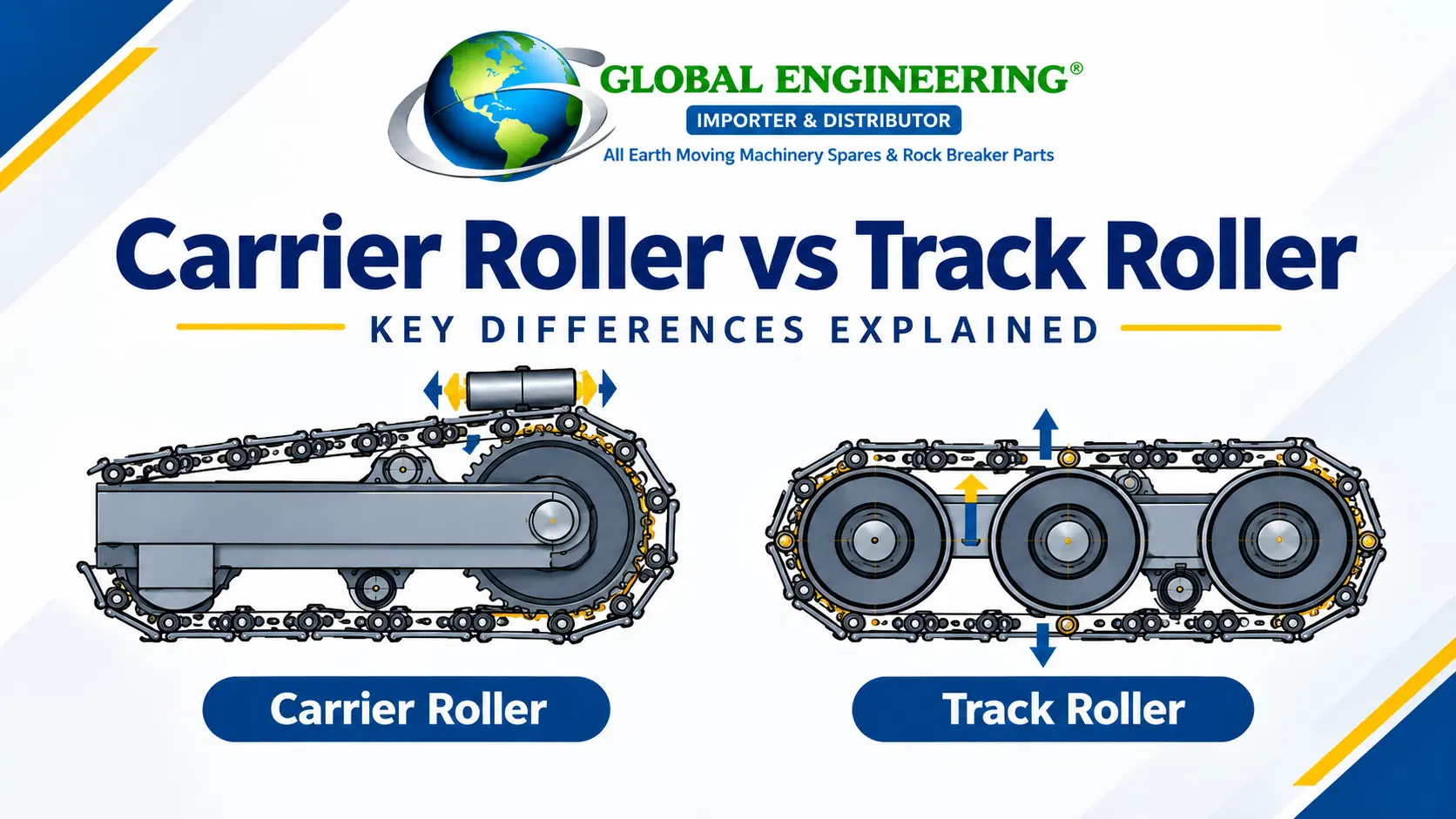
The carrier roller is mounted on the top of the undercarriage frame on the upper surface, above the track chain. It sits between the front idler and the rear drive sprocket, supporting the track chain as it returns along the upper run from the sprocket back to the idler. Because it sits on top, it is also called the top roller or upper roller.
The track roller is mounted on the bottom of the undercarriage frame directly below the machine, in a row running along the underside between the idler and the sprocket. It sits beneath the track chain, with the chain running below it in contact with the ground. Because it sits at the bottom, it is also called the bottom roller or lower roller.
One is at the top. One is at the bottom. That single positional difference drives every other difference between them in load, in quantity, in wear rate, and in how each one fails.
What Each Roller Does
Carrier Roller Function
The carrier roller has one primary job: prevent the upper run of the track chain from sagging. When the track chain leaves the drive sprocket at the rear and begins its return journey back to the front idler along the top of the undercarriage, gravity pulls the chain downward. Without a carrier roller to support it, the chain would sag and droop, dragging on the upper frame, wearing the chain links against metal, and creating uneven tension through the system.
The carrier roller holds the chain up, keeps it at the correct height, and guides it in a straight line back to the idler. It does this under a relatively light load; the returning track chain has no machine weight pressing down on it from above. The carrier roller supports the weight of the chain itself, nothing more.
Most excavators have one carrier roller per side, two in total. Some larger machines carry two per side.
Track Roller Function
The track roller does something far heavier. It carries the full operating weight of the excavator as the machine travels. As the machine moves, the full weight of the engine, counterweight, cab, hydraulics, boom, arm, bucket, and any attached load presses down through the undercarriage frame onto the row of track rollers mounted along the bottom. Each track roller transfers a portion of that weight to the track chain below it, which distributes it to the ground through the track plates. At the same time, the track roller guides the lower run of the track chain, keeping it running in a straight, stable path and preventing the chain from shifting sideways during travel. Most mid-size excavators have four to seven track rollers per side, eight to fourteen in total. Larger machines with longer track frames carry more to spread the higher operating weight across a greater contact length.
Key Differences at a Glance
Carrier Roller (Top Roller)
Position: Top of undercarriage frame
Also called: Top roller, upper roller
Primary function: Prevents upper chain from sagging
Load carried: Light chain weight only
Quantity per side: 1–2
Flange type: Center-flanged, single flange
Wear rate: Slower, lighter load
Failure consequence: Chain sag, uneven tension, chain wear
Replacement frequency: Less frequent
Service life: 3,000–6,000 hours (typical)
Track Roller (Bottom Roller)
Position: Bottom of undercarriage frame
Also called: Bottom roller, lower roller
Primary function: Carries the machine's full weight
Load carried: Heavy full machine operating weight
Quantity per side: 4–7
Flange type: Single or double flange options
Wear rate: Faster, heavier continuous load
Failure consequence: Chain misalignment, machine vibration, chain and frame damage
Replacement frequency: More frequent
Service life: 3,000–6,000 hours (varies by load and ground)
Load Difference: The Most Important Distinction
The load difference between the two rollers is the most important thing to understand because it determines everything else: the wear rate, the bearing design, the seal requirements, and the cost of failure.
The carrier roller at the top carries only the weight of the chain itself. A 20-tonne excavator's track chain weighs a few hundred kilograms per side. The carrier roller is holding up a fraction of a tonne, a relatively gentle load that barely changes during operation.
The track roller at the bottom carries the machine's full operating weight divided by the number of rollers in the row. On a 20-tonne excavator with six bottom rollers per side, each roller is carrying roughly 1.5 to 2 tonnes at rest and significantly more during digging, pushing, or travel across uneven terrain, when dynamic loads well above the static machine weight are transferred through the undercarriage frame.
This is why the track roller is a heavier, more robust component than the carrier roller. It has a larger outer diameter, a stronger bearing assembly, and a more demanding seal requirement. It also wears faster and is replaced more frequently across a machine's life.
When buyers assume the two rollers are interchangeable because they look similar they are not. The dimensional, structural, and load-rating differences are significant.
How Each Roller Fails
Understanding how each roller fails helps operators catch problems early before a failed roller damages the track chain, the machine frame, or the components around it.
How the Carrier Roller Fails
The carrier roller's most common failure mode is seal deterioration. As the duo-cone floating face seal wears over time, it begins to allow the factory-filled grease to escape from the bearing cavity. Once the grease level drops, the bearing begins to run dry. Dry running accelerates bearing wear rapidly, and the roller eventually seizes, locking in place rather than rotating freely.
A seized carrier roller causes the track chain to drag across a stationary surface rather than roll over a rotating one. The contact point wears a groove into the chain link rail surface and into the roller shell simultaneously. The chain begins to sag unevenly, and tension distribution across the undercarriage becomes irregular.
Early signs of carrier roller failure:
- * Oil weeping or leaking from the roller end faces
- * Squealing or grinding noise from the upper undercarriage during travel
- * Visible track sag between the idler and sprocket on the upper run
- * Uneven or accelerated wear on specific upper chain links
How the Track Roller Fails
The track roller fails under higher loads and in a harsher environment than the carrier roller. Its most common failure modes are seal failure, the same as the carrier roller, and shell wear from the abrasive contact of the track chain rail surface pressing against the roller shell under full machine weight.
When the seal fails on a track roller, contamination from mud, sand, or water enters the bearing cavity and rapidly accelerates bearing wear. A track roller bearing operating in contaminated grease can fail in a fraction of its expected life.
When the shell surface wears beyond its serviceable limit or sustains impact damage, flat spots or grooves form on the outer surface. A flat-spotted track roller bounces on the chain with every revolution, creating a rhythmic impact load that stresses the chain links and transmits vibration through the machine frame.
Early signs of track roller failure:
- * Oil leak from the roller end faces
- * Flat spots or groove wear visible on the shell surface
- * Audible knocking or grinding from the bottom of the undercarriage
- * Visible wobble or lateral movement during rotation
- * Uneven wear on specific lower chain links
- * Machine vibration during travel on flat ground
- * Increased fuel consumption without explanation
Which One Wears Out First?
In most operating conditions, the track roller wears out before the carrier roller for the simple reason that it carries far more load.
However, there are conditions where the carrier roller deteriorates ahead of schedule:
- * Machines that travel long distances Long-distance machine travel puts proportionally more load on the carrier roller than digging or lifting work does. Machines that regularly travel between worksites on their tracks rather than being transported on flatbeds wear out carrier rollers faster than machines that mainly dig in one place.
- * Operating on slopes Side-slope work creates lateral forces on the upper chain run that the carrier roller must resist. This increases the load on the carrier roller's flanges and bearing, accelerating wear.
- * Machines without adequate track tension A loosely tensioned chain sags more on the upper run, pressing harder against the carrier roller with each revolution.
In practice, most maintenance schedules replace track rollers more frequently than carrier rollers, but the carrier roller should always be inspected at the same time, not assumed to be fine because it carries less weight.
Can You Replace One Without the Other?
Yes, they are separate components and can be replaced independently. Replacing a failed carrier roller does not require touching the track rollers, and vice versa.
However, there are situations where inspecting both at the same time makes sense:
- * When removing the track chain for any reason with the chain off, both roller types are fully accessible and can be inspected without additional labor cost
- * When one roller in a row has failed if the failed roller was installed at the same time as the others, the adjacent rollers may be at a similar wear stage and worth replacing together to avoid a second machine stoppage shortly after
- * When planning a full undercarriage rebuild, replacing all undercarriage components together, such as the track chain, rollers, idler, and sprocket as a kit, gives a known service life starting point and avoids the staggered replacement cycle that occurs when components of different ages are mixed
Ordering the Right Roller What to Tell Your Supplier
When ordering either roller, the information your supplier needs is the same:
- * Machines made by Komatsu, Hitachi, Caterpillar, Volvo, Hyundai, Doosan, JCB, etc.
- * Machine models PC200, ZX200, 320, EC210, R210, DX225, JS200, etc.
- * Machine serial number The most reliable identification method; eliminates ambiguity between model variants
- * Which roller type: carrier roller (top roller) or track roller (bottom roller)
- * For track rollers: flange type (single flange or double flange), and which position in the row
Never order a track roller based on physical measurement of a worn shell; the outer diameter of a worn roller is smaller than its original dimension, and measuring it will lead you to order an undersized replacement. Always cross-reference against the machine serial number or OEM part number.
Popular Posts